What 45 experiments on IBM Heron actually taught us
The campaign behind the foundational paper, and the three findings that changed how the second one was designed.
Research 2 min read 
The foundational QANTIS paper runs to 31 pages with 4 figures and 12 tables, and most of that volume is one thing: a 45-experiment campaign across three IBM Heron backends. People sometimes ask why a paper needs that many runs. The short answer is that fewer would have let us believe things that were not true.
The three components
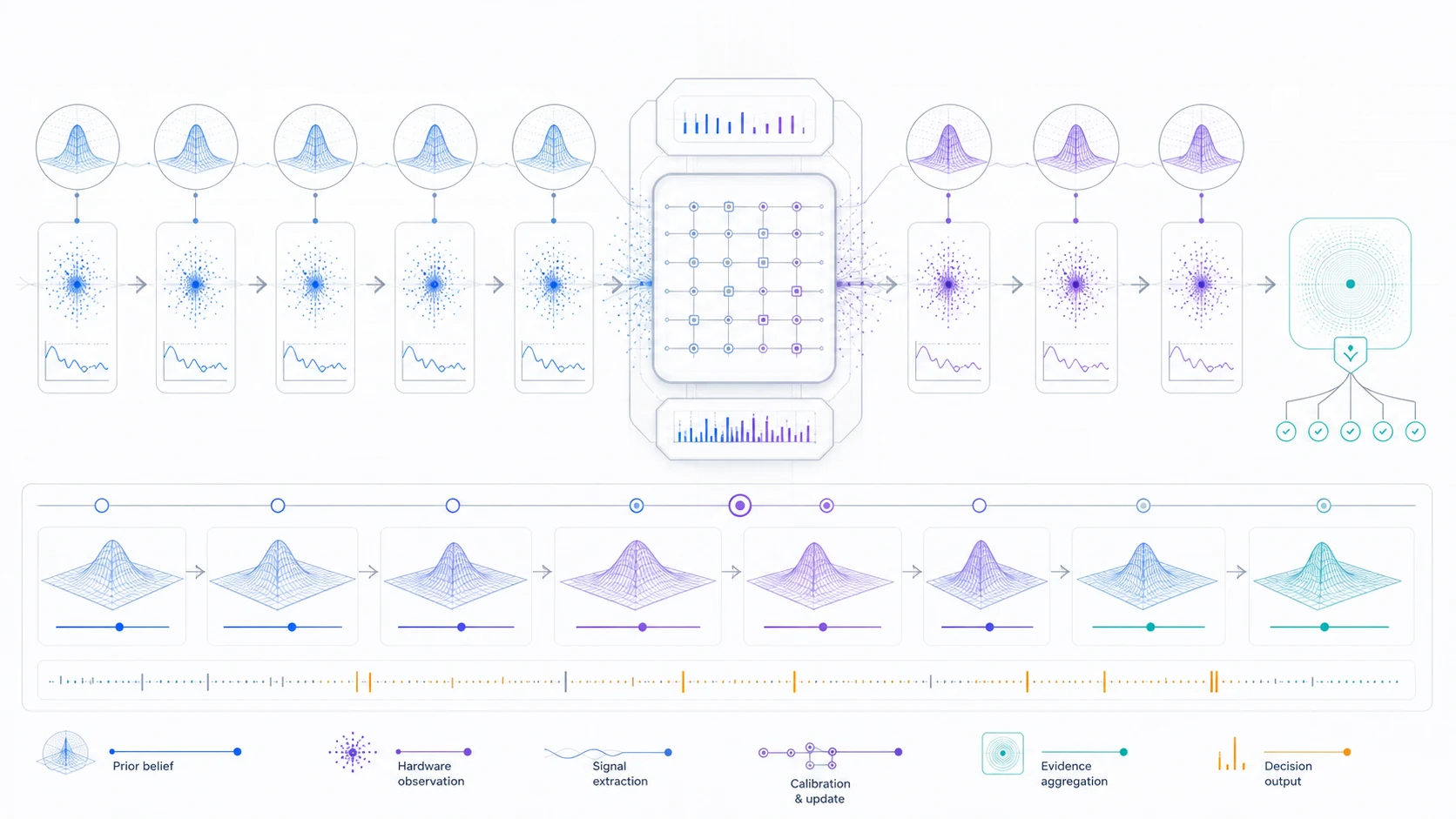
The platform integrates three pieces that are usually studied separately. Quantum belief update through Grover amplitude amplification and BIQAE. Multi-target data association posed as a QUBO and solved with FPC-QAOA. Composable error mitigation applied across both.
Studying them together was the point. A belief-update result measured in isolation tells you very little about what happens when the same hardware, in the same calibration state, also has to carry an association problem.
What the campaign changed
Backend identity matters more than backend specification. Three Heron processors with the same nominal specification did not behave interchangeably. Results that looked like method effects on one backend turned out to be calibration effects when the same circuit ran elsewhere. Any result reported without naming the backend and the calibration window is a result you cannot reproduce, and we started treating that as a hard requirement rather than good practice.
Mitigation composes badly if you let it. Error mitigation techniques that each improve a result individually can interact in ways that make the combination worse than either alone. That is not a surprising claim once stated, and it is very easy to miss if you only ever evaluate one configuration.
The interesting numbers are at the boundary. The clean result in the paper, a rare-observation probability amplified from 0.179 to 0.907 with a Hellinger distance of 0.0015 from exact Bayes, is a centre-of-envelope result. It is real and it is not where we learned the most. The runs that taught us something were the ones near the edge of what the hardware could hold.
How it shaped the second paper
The sequential study exists because of a gap the first campaign made obvious. Every one of those 45 experiments was, in the end, a single-shot measurement of a mechanism. None of them told us what happens when the belief-update service is called repeatedly and its output feeds the next prior.
So the follow-on asks exactly that, across a sequential Tiger POMDP horizon, with 8-step and 12-step primary campaigns and 20-step and 32-step controls. The controls are there specifically to find the failure, not to confirm the success.
The thing I would tell someone starting
Design the campaign so that a null result is publishable.
If your experiment plan only produces a paper when the method works, you have built an incentive to stop looking at the point where it stops working. The 45-experiment structure was expensive in queue time and it meant that whichever way the result went, we had something to report. That is worth paying for.
Both papers are public preprints on arXiv. Neither has been peer-reviewed, and neither claims wall-clock advantage over strong classical methods.